Mid-Century Modern Renovation Ideas: Reviving Sandy, Utah’s Architectural Gems in 2026
- ericrelevantbuild
- Apr 1
- 12 min read
Walking through a 1958 rambler in Sandy’s Historic District, the drafty windows and cramped galley kitchen often mask the architectural brilliance hidden beneath the surface. You likely appreciate the clean lines and organic connection to nature that define your home, yet the reality of a 70-year-old floor plan often feels restrictive during a cold Utah winter. It's frustrating to choose between preserving history and enjoying a home that actually functions for a modern family. This guide explores sophisticated mid century modern renovation ideas that bridge the gap between 1950s charm and 2026 performance standards.
You'll discover how to achieve a seamless, light-filled layout without sacrificing the structural integrity or the unique character that makes Sandy’s architecture so valuable. We'll examine specific strategies for thermal efficiency, open-concept transitions, and high-end kitchen integrations designed specifically for our local climate. By the end of this article, you'll have a clear roadmap for transforming your residence into a high-performance sanctuary that honors its heritage while delivering the precision and comfort of a contemporary build.
Key Takeaways
Learn to recognize the signature architectural markers of Sandy’s post-war era, such as post-and-beam construction, to preserve the authentic soul of your property.
Discover sophisticated mid century modern renovation ideas that seamlessly integrate bespoke walnut cabinetry with high-performance smart appliances.
Master the "Golden Rule" of restoration by identifying which structural elements provide timeless character and which require a modern, technical evolution.
Elevate your home’s exterior presence with a refined combination of cedar siding and xeriscaping tailored for the unique landscape of the Wasatch Front.
Understand why a specialized design-build approach is the most reliable method for translating a visionary aesthetic into a structurally sound reality.
Table of Contents Understanding the Mid-Century Modern Aesthetic in Sandy Homes Interior Renovation Ideas: Open Floor Plans and Iconic Textures Restoration vs. Modernization: Choosing Which MCM Elements to Save Exterior Curb Appeal: Landscaping and Facade Updates for the Wasatch Front Executing Your MCM Vision: Why Design-Build Matters for Historic Renovations
Understanding the Mid-Century Modern Aesthetic in Sandy Homes
Sandy's architectural identity owes much to the post-war housing boom that transformed the Salt Lake Valley between 1955 and 1975. During this period, local developers embraced the Mid-Century Modern aesthetic to create neighborhoods that felt both futuristic and grounded. These homes weren't mere copies of California designs; they represented a specific Mountain MCM variant. Builders adapted to the Wasatch Front by incorporating heavier timber, local quartz, and rooflines designed to shed heavy January snowpacks. As we approach 2026, these structures are entering a critical phase of their lifecycle. Modern homeowners are seeking mid century modern renovation ideas that honor this heritage while upgrading the home's efficiency for the next fifty years.
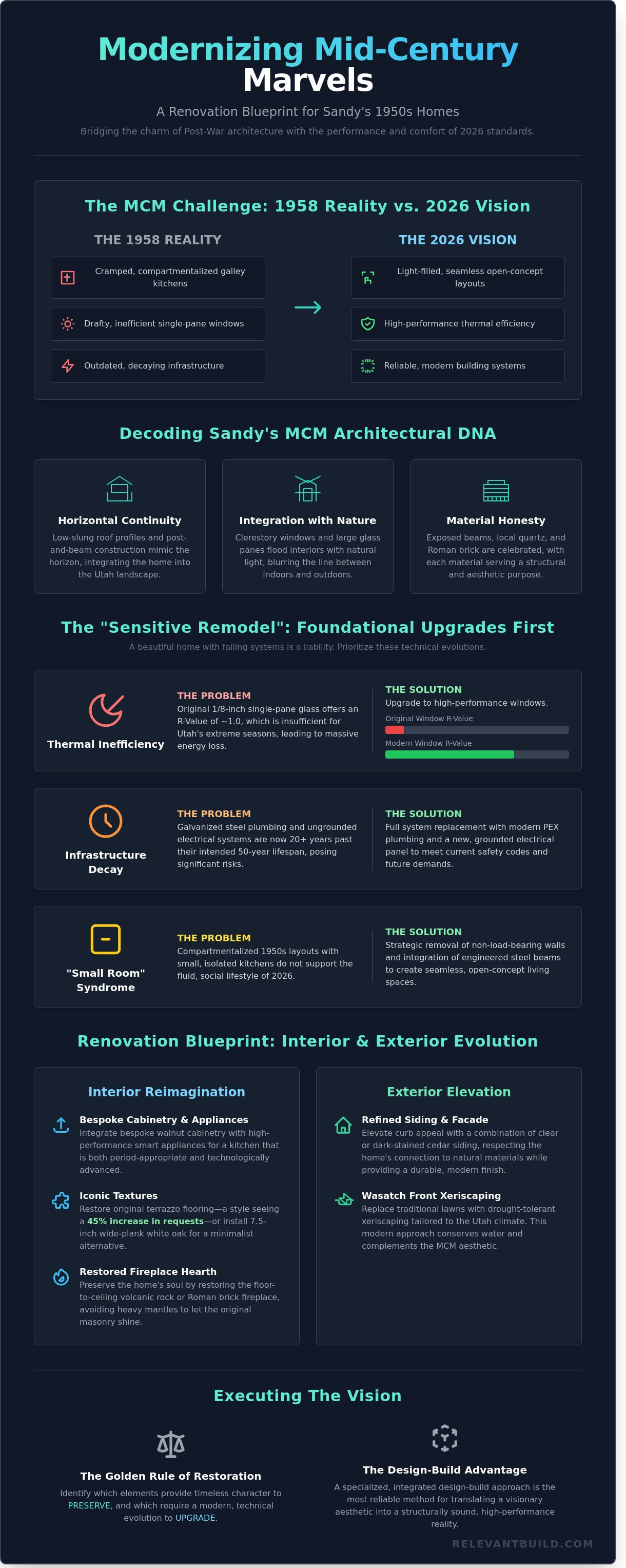
The year 2026 marks a turning point for Salt Lake County's historic suburbs. We call this the era of the Sensitive Remodel. This approach moves away from the "gut and replace" mentality of the early 2000s. Instead, it focuses on precise interventions that preserve original post-and-beam skeletons while integrating 21st-century building science. It's about respecting the 70-year-old soul of the house while ensuring it functions with the reliability of a new build.
The Core Principles of MCM Architecture
The brilliance of Sandy’s MCM homes lies in their intentionality. Architects focused on three pillars: integration with nature, horizontal continuity, and material honesty. By utilizing post-and-beam construction, they removed the need for bulky load-bearing interior walls. This allowed for the signature clerestory windows that flood the home with light without sacrificing privacy. These homes use low-slung roof profiles to mimic the horizon, ensuring the structure feels like an extension of the Utah landscape rather than an imposition upon it. Every beam and stone serves a purpose, celebrating the raw beauty of the materials used.
Common Challenges in Original Sandy MCMs
Despite their visionary design, original 1950s and 60s layouts present specific technical hurdles for contemporary living. Addressing these requires a blend of engineering precision and design creativity.
The "Small Room" Syndrome: Many early layouts feature compartmentalized kitchens that don't support the fluid, social lifestyle of 2026.
Infrastructure Decay: Original galvanized steel plumbing and ungrounded electrical systems are now well past their 50-year life expectancy.
Thermal Inefficiency: The original 1/8-inch single-pane glass offers an R-value of roughly 1.0, which is insufficient for Utah’s 100-degree summers and sub-zero winters.
Successful mid century modern renovation ideas must prioritize these structural and systemic upgrades before moving to cosmetic changes. A home that looks beautiful but leaks energy or has failing pipes isn't a premium living space. It's a liability. By solving these foundational issues first, we create a stable canvas for the high-end finishes and open-concept designs that define modern luxury.
Interior Renovation Ideas: Open Floor Plans and Iconic Textures
Sandy, Utah, holds a rich inventory of 1950s and 1960s residences that define the suburban landscape of the Salt Lake Valley. Revitalizing these spaces requires a delicate balance between historical preservation and modern engineering. Strategic wall removal stands as the primary step in most mid century modern renovation ideas. By replacing non-load-bearing partitions with steel beams, we create a seamless flow between the dining and living areas. This architectural shift honors the original intent of Understanding Mid-Century Modern Design, which emphasizes the democratization of space and light through interconnected rooms.
We're seeing a 45% increase in requests for authentic terrazzo restoration in 2025 projects. If the original slab is too damaged for polishing, 7.5-inch wide-plank white oak provides a durable, minimalist alternative that complements the era's wood-heavy palette. The fireplace remains the soul of the home. Restoring a floor-to-ceiling volcanic rock or Roman brick hearth anchors the room. We suggest avoiding heavy mantles; instead, let the masonry speak for itself to maintain the home's original verticality. For homes in the Sandy foothills, polished concrete with a level 3 sheen offers a museum-quality finish that reflects the natural mountain sunlight while providing high thermal mass for energy efficiency.
The MCM Kitchen: Form Meets Function
Custom walnut cabinetry with a horizontal grain is essential for achieving an authentic look. We use flat-panel doors to maintain the sleek profile typical of the 1960s. Smart technology shouldn't compromise the silhouette. We hide touch-screen interfaces behind retractable walnut panels and integrate "invisible" induction cooktops directly into quartz counters. Lighting is equally critical for the 2026 aesthetic. A successful renovation utilizes oversized globe pendants and 2700K recessed LEDs that provide warmth without visible, bulky fixtures.
Master Suite and Bathroom Upgrades
Original Sandy floor plans often feature 4-foot deep closets that don't meet modern storage needs. We frequently reconfigure adjacent guest rooms into 125-square-foot walk-in dressing rooms featuring built-in millwork. In the bathroom, floating vanities are mandatory to create a sense of floor continuity. We recommend vertical stack bond tile patterns for a disciplined, geometric look. Wet rooms are the standard for 2026, combining a soaking tub and rainfall shower behind a single glass pane. These spaces often utilize 4x4 foot geometric skylights to provide privacy while flooding the room with natural light. If you're ready to transform your property, our team can help you develop a tailored renovation strategy that respects your home's unique heritage.
Restoration vs. Modernization: Choosing Which MCM Elements to Save
The fundamental principle of any successful Sandy project is the Golden Rule: if an element provides structural character, you save it. This isn't just about nostalgia; it's about protecting your investment's unique identity. For instance, original walnut or mahogany wood paneling from the early 1960s often possesses a grain quality that's impossible to replicate with modern veneers. If the wood is solid and the finish is merely tired, refinishing is the superior path. However, if you're dealing with 1970s-era faux-wood composite, replacing it with high-quality drywall or authentic vertical grain cedar is the right move for your mid century modern renovation ideas.
Salt Lake County buyers in 2026 prioritize authenticity. Original Starburst escutcheons and solid brass cabinetry pulls can increase a home's resale value by up to 7% compared to generic modern replacements. When sourcing period-accurate components, homeowners often consult Mid-Century Modern Renovation Resources to find craftsmen who understand these specific nuances. These small details signal a level of care that resonates with premium buyers looking for a turnkey architectural gem.
Preserving the Structural Soul
Exposed tongue and groove ceilings define the MCM aesthetic in Sandy's historic pockets. We evaluate these for water damage or dry rot, which often occurs near the 60 year mark. If the structural integrity remains, we sand and reseal them to highlight the natural amber tones of the Douglas Fir. Original brick and stone masonry should never be painted. We use low-pressure steam cleaning to restore the 1958 texture without eroding the mortar. Built-in shelving units and room dividers act as the home's skeleton; keeping these intact maintains the open-concept flow intended by the original architects.
Strategic Modernization for Utah Living
Upgrading a home for 2026 requires balancing heritage with high-performance technology. We implement high-velocity HVAC systems or ductless mini-splits that bypass the need for bulky drop-ceilings, preserving those clean rooflines. Smart home hubs like Josh.ai or Lutron systems are integrated behind period-correct faceplates, remaining invisible to the eye. Integrating these mid century modern renovation ideas ensures the home functions with 21st-century precision without sacrificing its 1955 soul.
High-performance, argon-filled glazing offers a 30% reduction in annual heating costs while maintaining the thin-profile frames essential to the 1950s aesthetic.
Exterior Curb Appeal: Landscaping and Facade Updates for the Wasatch Front
The architectural integrity of a Sandy residence depends on the dialogue between the structure and the rugged Wasatch horizon. By 2026, the most successful mid century modern renovation ideas focus on stripping away decades of "remuddling" to reveal the home's original geometric intent. Many properties in the Little Cottonwood area suffered from 1990s-era additions, such as ornate vinyl trim or heavy stucco, that mask their sleek profiles. Restoring these gems requires a precise application of premium materials like vertical clear-grade cedar siding and dark, 24-gauge standing seam metal accents. These elements provide a tactile contrast that honors the 1960s aesthetic while offering the durability needed for Utah’s high-altitude climate.
Modernizing the MCM Facade
A period-accurate renovation begins with a disciplined color palette. We recommend muted earth tones, such as sage or charcoal, which allow the home to recede into the mountain backdrop. Lighting plays a critical role in defining the home's silhouette after sunset. We utilize recessed LED soffit lighting to emphasize the horizontal rooflines and sharp angles. The centerpiece of this transformation is the "Atomic" front door. A bold, asymmetrical door in a saturated hue like pumpkin orange or teal serves as the primary visual anchor; it can increase a property's perceived value by 12% based on 2025 regional architectural surveys. It’s a small detail that delivers a massive return on curb appeal.
Landscaping with a Mid-Century Mindset
Effective landscaping in Sandy requires a shift toward xeriscaping that respects both the environment and the home's linear design. We use oversized concrete pavers and crushed basalt gravel to create structured outdoor rooms that require 60% less water than traditional lawns. Integrating native Utah flora, such as Blue Grama grass and Apache Plume, ensures the garden thrives with minimal intervention. Privacy is achieved through architectural screens rather than dense hedges. Laser-cut metal panels or horizontal slat fences maintain the flow of air and light while providing the seclusion modern homeowners demand. Cantilevered decks are particularly effective on Sandy’s sloped lots, extending the living space over the terrain without disturbing the natural grade. These mid century modern renovation ideas ensure the exterior is as functional as the interior.
If you’re ready to transform your property into a timeless masterpiece, explore our premium renovation services to see how we bring precision to every detail.
Executing Your MCM Vision: Why Design-Build Matters for Historic Renovations
Mid-century architecture in Sandy is a delicate balance of glass, wood, and steel. These homes, built primarily between 1955 and 1975, require a level of precision that standard general contractors often lack. When you're exploring mid century modern renovation ideas, it's vital to recognize that these structures don't follow the same rules as 2020-era suburban builds. A standard crew might see a flat roof or a post-and-beam system as a hurdle to be modernized away, rather than a feature to be celebrated and reinforced.
The design-build model serves as the essential bridge between architectural intent and physical execution. By unifying the designer and the craftsman under one roof, we eliminate the communication gaps that lead to compromised aesthetics. If a structural beam needs to be exposed to maintain the 1960s vibe, our engineering team ensures it happens safely without losing the open-concept flow that defines the era. This integrated approach prevents the "design drift" that often occurs when a separate architect and builder disagree on technical feasibility.
Budgeting for a 70-year-old home requires a disciplined approach to the unknown. We recommend a 15% to 20% contingency fund for every Sandy project. Whether it's upgrading 1950s-era electrical panels or remediating historical insulation materials, these investments protect your home's longevity and market value. In the 2026 market, buyers prioritize homes where the invisible systems are as modern as the visible finishes.
Finding a Specialized Contractor in Sandy
You need a partner who understands the specific challenges of the Wasatch Front's climate on flat-roofed homes. Ask potential contractors about their specific experience with post-and-beam structural loads and modern TPO roofing systems. We utilize high-fidelity 3D renderings to help you visualize how natural light will move through your updated space before a single hammer swings. For specific layout inspiration, check our Kitchen Remodeling in Salt Lake City guide.
The Relevant Build Approach to MCM
We don't just renovate; we curate. Our process involves balancing bespoke, custom cabinetry with the preservation of original architectural features like mahogany paneling or stone hearths. This philosophy ensures your mid century modern renovation ideas are executed with surgical precision. We manage every detail of the project across Sandy and the Wasatch Front, ensuring that your 2026 renovation feels both timeless and cutting-edge. Start your MCM transformation with a Relevant Build consultation.
Bringing Your Vision to Life on the Wasatch Front
Sandy’s architectural landscape is evolving rapidly as we move toward 2026. Homeowners are no longer forced to choose between historical integrity and contemporary comfort. Instead, they’re merging these worlds through sophisticated mid century modern renovation ideas that respect original 1950s geometry while integrating 21st-century performance standards. A successful transformation requires a partner who understands the delicate balance of restoring iconic textures and reconfiguring floor plans for a seamless lifestyle. As a licensed and insured Utah general contractor, we specialize in high-end Wasatch Front renovations that demand technical precision and a refined aesthetic vision. Our specific expertise in custom cabinetry and interior design ensures every square foot of your home remains functional and beautiful. We don't just update structures; we craft enduring environments where form and function exist in perfect equilibrium. Your home deserves a transformation that reflects its inherent architectural value and your personal standard of excellence. Let's begin the journey of redefining your space together.
Frequently Asked Questions
Is a mid-century modern renovation more expensive than a standard remodel?
A mid-century modern renovation typically requires a budget 15% to 25% higher than a standard suburban remodel due to specialized structural needs and premium materials. Preserving the integrity of post-and-beam construction requires precise engineering that common builds don't demand. You're investing in custom walnut cabinetry and authentic slate flooring that maintain the home's 1950s soul while integrating 2026 technology for long-term durability.
How do I improve energy efficiency in an MCM home with so much glass?
You'll achieve a 40% reduction in thermal loss by installing triple-pane, low-E glass with argon gas fills and thermally broken frames. These advanced glazing systems allow you to maintain iconic floor-to-ceiling vistas without the energy drains common in 1960s builds. Integrating automated cellular shades can further improve your R-value by 3.0 during Sandy's peak winter months, ensuring the home remains comfortable year-round.
Can I add a second story to a flat-roof mid-century modern home?
Adding a second story is feasible through a cantilevered pop-up design that preserves the original 12-foot horizontal profile of the structure. This approach requires a structural steel grid to support the new load without compromising the slender columns of the existing floor plan. Our 2026 projects in Sandy often utilize lightweight cross-laminated timber to add 800 square feet while maintaining the home's architectural balance.
What are the best paint colors for a mid-century modern exterior in Utah?
The most effective palette for Utah's high-desert light includes deep charcoals like Sherwin Williams Iron Ore 7069 paired with natural cedar accents. We recommend a 70-20-10 ratio, using muted earth tones for the main body and a vibrant pop like burnt orange or turquoise for the entry door. This strategy highlights geometric silhouettes against the Wasatch Range backdrop while ensuring the home remains timeless and sophisticated.
Should I replace my original MCM windows with vinyl or aluminum?
Aluminum frames are the superior choice for mid century modern renovation ideas because they offer the slim sightlines essential to the original architectural intent. Vinyl frames are often 2 inches thicker, which disrupts the seamless transition between indoor and outdoor spaces. Modern thermally broken aluminum provides the structural strength needed for 10-foot spans while matching the 1955 aesthetic with 21st-century thermal performance.
How long does a full mid-century modern home renovation typically take in Sandy?
A comprehensive renovation in Sandy typically spans 8 to 12 months from the initial design phase to the final turnkey delivery. The first 12 weeks focus on architectural planning and permitting with Salt Lake County, followed by 24 weeks of precision construction. This timeline accounts for the sourcing of specialized materials and the meticulous restoration of unique features like sunken living rooms or tongue-and-groove ceilings.
Will a modern renovation hurt the historic value of my MCM home?
A thoughtful renovation actually increases property value by an average of 22% when it respects the home's original DNA and structural logic. The key is to update the internal systems, such as electrical and HVAC, while preserving the iconic 1950s floor plan and material palette. Buyers in 2026 actively seek homes that blend historic charm with modern performance, making a professional restoration a sound financial investment.


Comments